

The Un-Engineered Data Layer: Who Holds the Keys to Your Data (Part 3)



- You can have a managed service without handing over your keys: Running the database control plane inside your own cloud account keeps databases, snapshots, backups, metadata, and keys in your environment, with operator access that is least-privilege and revocable.
- Lock-in stacks up: Moving a commercial database onto a single cloud can add a second dependency rather than replace the first. The real test is whether your operational runbooks look the same on every cloud.
- AI readiness is ongoing, not a one-time cleanup: It comes down to a few honest numbers: how fresh the data needs to be, how fast someone can get a safe copy, whether production still hits its SLAs, and whether the agent actually moved the business.
- Start with one metric: Don't break the operational system. Get the measures in place before an AI query becomes an outage.
Who actually holds the keys to your data in the cloud? How locked in are you, really? And when AI agents start touching production, which numbers tell you whether it's working or quietly breaking something?
Part 1 of this series looked at why Oracle and SQL Server migrations miss on ROI. Part 2 followed the database onto the balance sheet: consolidation, governance at AI speed, and AI inside the database itself. Part 3 takes the conversation to the boardroom.
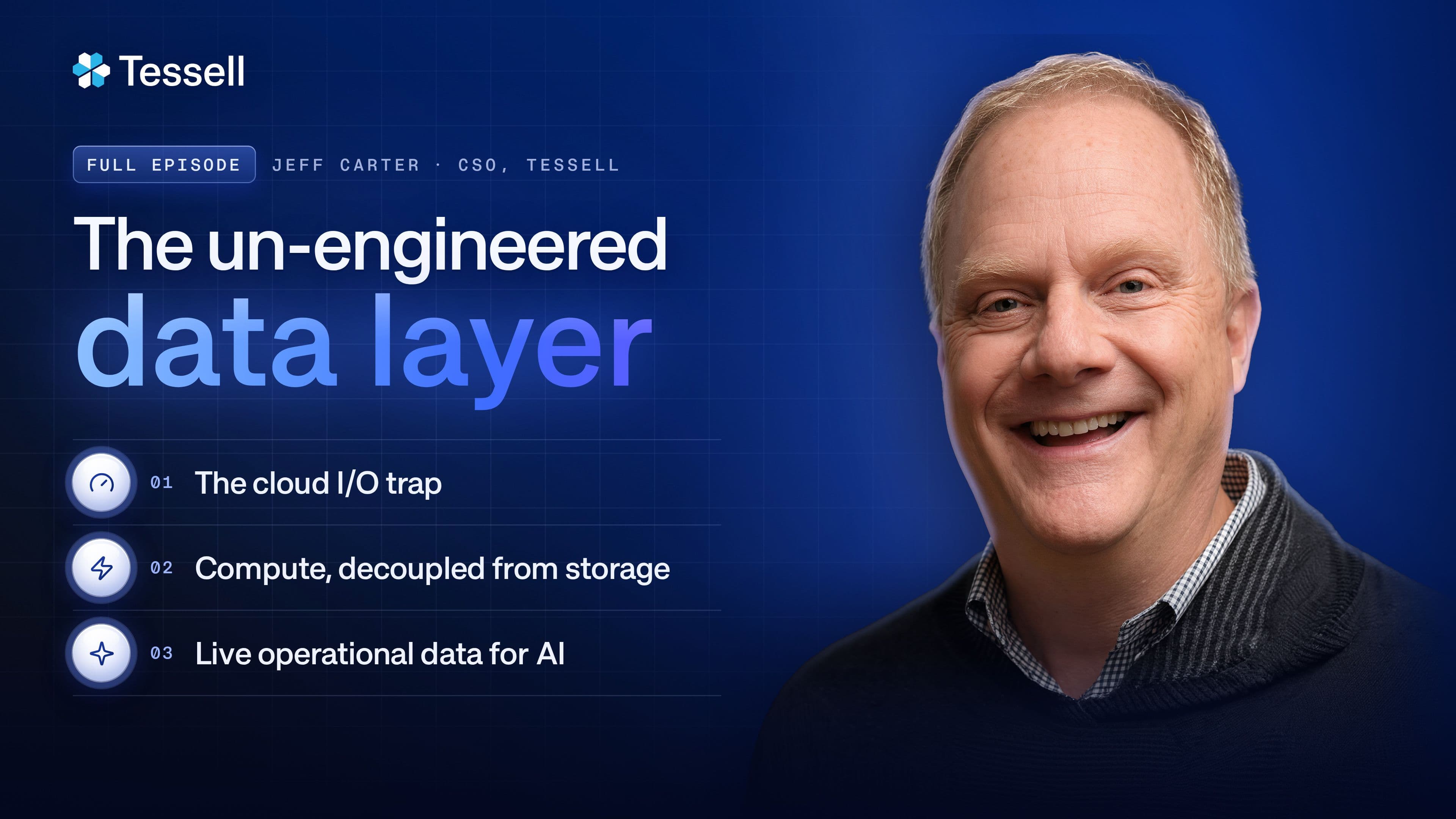
Jeff Carter, Tessell's Chief Strategy Officer, former VP of AWS Databases, and former CISO of Amazon's businesses outside of AWS, sits down again with Tim Davis, Senior Director of Presales at Tessell, for three questions: who controls the database, how to keep your options open across cloud providers, and what a CIO should be measuring right now.
Who holds the keys
Tim Davis asks: Almost every regulated customer we work with is asking about this. Are you seeing more companies that want to own and control where their database actually lives? And does running a managed database service inside the customer's own cloud account (their VPC, their subscription, their keys) give engineering the speed it wants without making the CISO nervous?
We're definitely hearing this a lot. Customers increasingly want ownership and control, and that's only growing. It has existed for a while in government accounts, in certain regions of the globe, and in regulated industries. Data sovereignty concerns are not going away, and I fully expect this trend to keep growing.
Let's split it into two options.
Option one: the cloud vendor owns it
The cloud vendor is the true owner of your database system. They also own the control plane, and they give you access to it, typically only at the level of database administrator and user. There's no root access on Linux and no administrator access on Windows Server. As an example, the cloud vendor creates a backup on your behalf and then gives you access to the output.
Option two: you own it, Tessell runs it
Tessell can operate in that first mode, managing the control plane and the system for you. But Tessell also has a second option: you host the database management service in your own cloud account, with your own keys. In this mode, Tessell's control plane is effectively an application you operate in your own cloud environment, in your VPC.
The databases, snapshots, backups, and keys all stay in your VPC or subscription. The metadata stays in your environment too. When Tessell operators need to do something, they have a least-privilege role on a resource group, and that role is bounded and can be revoked at any time.
That combination makes the operating model more portable across clouds, which lets you, and perhaps your procurement organization, consider alternative cloud vendors if and when that's needed.

Follow-up: Where is that demand coming from hardest right now? Government, certain regions of the world, regulated industries?
I see it in all of those places. But there's a new concern I'm hearing from people across the industry: that their AI and their data, through RAG or other means, may end up in the hands of the LLM vendors, who could use it as a competitive threat in the future.
So people are increasingly interested in having control over their inference, and being able to run it within their own environment, or even within their own cloud or cloud-like services on-premises. That's something we should keep watching. If there's ever a negative event involving the LLM vendors, it could really accelerate.
Lock-in doesn't go away. It stacks up.
Tim Davis asks: A lot of people say that moving off legacy database licensing and onto a single hyperscaler just swaps one kind of lock-in for another. Is that how you see it? And where does an engine-agnostic, multi-cloud control plane actually give a company leverage at the negotiating table?
In some cases I'm not sure it's a swap. In some cases it can be additive.
Here's an example. It applies to any commercial database and any cloud. If you're running a commercial database on-premises and you move it to a single cloud, you may now depend on both vendors. Part of your operations keeps its dependency on the database vendor, and you pick up new dependencies in your runbooks that are specific to that cloud. You've effectively doubled the lock-in.

Keep in mind that the database and its control plane are the stateful parts of an application. That's where the history and the meaning live: your customers, your orders, your inventory. So when you think about portability across clouds, you have to consider every application that uses a given database and the data inside it.
With that said, the control plane is effectively an API for managing the database and the data. It abstracts the fundamentals of a cloud into a standard set of commands that can be consistent across clouds, and across multiple database engines.
So if you're worried about lock-in, look at your operational runbooks. When you do common database work (patching, high availability, backup, masking, cloning), are those steps cloud-specific? Do they only work with one provider's managed database service? What we hear from Tessell customers is that their runbooks are, as much as possible, database-engine and cloud agnostic. The runbooks look the same wherever the database runs, and that's ultimately what makes switching easier and lower cost.
Follow-up: If I'm a CIO and I want to know how locked in I really am, what should I look at first?
I'd run it as a theoretical test. Imagine a major vendor comes to you and says: we're investing a lot in AI, so we need to raise the price five to ten times. You have six to twelve months to decide before you have to pay it, and that's time you could use to adopt another technology.
If you find there's no way to avoid paying in that window, because you have no other options, then you're locked in.

The numbers a CIO should measure
Tim Davis asks: Say you're sitting across from a CIO or a VP of Engineering tomorrow. Forget the slideware. What are the handful of numbers they should go measure right now to find out whether their Oracle or SQL Server estate is really ready for AI? Things like how long it takes to get a governed copy of test data, IOPS per core, how many databases each engineer is carrying.
Let me start with a few high-level observations, and then I'll get specific.
Start with your customers
Whenever I look at metrics, I start with one question, and it comes from my time at Amazon and other customer-obsessed companies: are your customers being served well?
I divide customers into two groups. Big-C customers are the people who ultimately pay for your company's products and services. Even as an IT organization, you need to understand how your compute and processing contribute to those products and services, and you need measures for it. Small-C customers are your internal stakeholders, the partner business teams inside the organization. How well are you serving them, and do you have metrics for that?
The key is whether you have mechanisms to continually listen to both, across all your stakeholders.
Then ask the CISO's questions
This comes from my time as a CISO. Are you actively auditing for inappropriate use of data? When you find something, do you root-cause it and correct every finding?
In Part 2 we talked about an easy button for getting data to AI. Is yours working? Is it preventing unmanaged copies, or is it making the problem worse? And can you describe your system to your board of directors, and show how it adds value rather than creating problems?
None of this is a one-time project. Like cleaning the data, it's ongoing. Gartner puts it well: AI readiness is per agent and per SLA. If an agent needs live operational data, the metric is freshness and a governed path off the primary data source. It isn't another foundation-model bake-off. If you want to go deeper, I'd recommend Gartner's research by Roxane Edjlali and Mark Beyer, both of whom I've had the chance to work with. They're excellent. (See the sources at the end.)
Four measures to start with

Source freshness. Every application has its own tolerance for stale data. If you're looking at yesterday's revenue, nightly is probably fine, and it's likely the cheapest path. Do you need hourly, or several times a day for different regions? Is the lag from an asynchronous change data capture (CDC) feed acceptable, a fraction of a second out of date, or does it need to be synchronous? Each step toward real time costs more: in dollars and compute, in maintenance, or in transaction performance.
Safe access speed. How long does it take to provision a governed, non-production copy of the data? What percentage of copies are logged and sanitized? What's the p90 time to a policy-gated copy?
Don't break the operational system. I can't repeat this enough, and it's the point of Part 1's four approaches. If AI is directly accessing your operational systems, my guess is you have a house on fire. You may not know it yet, but at some point it will burn you. Track IOPS per licensed core and toil hours per database as real costs. If they start climbing because AI queries are coming in, act early. Sooner or later, some AI workload will have multiple users kick off multiple full table scans on your operational system, and your end users won't be happy.
Agent outcomes. To borrow McKinsey's framing: look at the business process before and after. Did the agent change the cycle time, the cost to serve, or the revenue? I'd add one more: did it provide value to your end, big-C customer?
These are based on my own experience and reading. I'd love to hear what others think are the important measures and success criteria in their businesses.
Follow-up: If a CIO could only track one of these next quarter, which would you pick, and why?
Don't let your house burn down. I'd go with not breaking the operational system. Get the metrics in place even if you're not seeing a problem today, because you want to detect it before the train goes off the rails. That's where I'd start, and I'd watch those numbers weekly and monthly.
Keep your data, your keys, and your options
Tim's three takeaways from the conversation:
Control matters more every year. You can have a managed service without handing over your data or your keys.
Lock-in doesn't go away when you move to the cloud. It stacks up. The real test is whether your runbooks look the same no matter which cloud you're on.
Getting ready for AI isn't a one-time cleanup. It comes down to a few honest numbers: how fresh your data is versus how fresh it needs to be, how fast someone can get a safe copy, whether production is still hitting its SLAs, and whether the agent actually moved the business.
Jeff's closing advice: in a new world of AI agents, keep your data, your keys, and your options in your own hands wherever you can. Measure whether AI is actually making life better for your end customers. And share what you're measuring and what's helping you predict outcomes, because nobody has this fully figured out yet, and we need to learn from each other at the pace of AI innovation.
This is the final part of The Un-Engineered Data Layer. If you missed the earlier parts, Part 1 covers the cloud performance trap and live operational data for AI, and Part 2 covers consolidation, data governance at AI speed, and AI inside the database platform.
If you want to keep your data, your keys, and your options in your own hands, talk to us.
Other sources
Edjlali, Roxane, Mark Beyer, et al. Quick Answer: What Makes Data AI-Ready? Gartner, 15 May 2024. ID G00809337.
Seth, Deepak, and Roxane Edjlali. Use This Checklist to Ensure Your Data Is Ready for the Agentic AI Era. Gartner, 20 August 2025. ID G00835373.