



What is DBaaS (Database as a Service)?
Database as a Service explained — architecture, benefits, deployment models, security, SLAs, pricing, and how to choose the right provider.

- DBaaS is a cloud service model where a third party provider hosts, manages, patches, and scales databases so engineering teams avoid infrastructure administration.
- DBaaS providers handle provisioning, automated backups, point in time recovery, security patching, failover, and elastic scaling across cloud environments.
- Key benefits include elastic scalability, zero RPO/RTO availability, faster deployment, reduced DBA overhead, and multi cloud portability across AWS, Azure, GCP, and OCI.
- Common DBaaS use cases include SaaS applications, AI and RAG pipelines using pgvector or Milvus, analytics workloads, IoT time series data, and enterprise OLTP systems.
- Choose a DBaaS provider based on engine coverage, multi cloud support, BYOA data sovereignty, RPO/RTO SLA guarantees, and compliance certifications such as SOC 2 and PCI DSS.
DBaaS (Database as a Service) is a cloud computing service model where a third-party provider hosts, manages, and maintains databases on behalf of customers. Users access the database over the internet and pay based on usage or subscription, while the provider handles provisioning, backups, security, patching, and scaling. DBaaS eliminates the need to manage underlying infrastructure, freeing engineering teams to focus on building applications rather than administering databases.
As enterprises accelerate cloud adoption, DBaaS has emerged as the default database delivery model for organizations that want enterprise-grade performance without the operational overhead of self-managed deployments. The global DBaaS market was valued at $17.2 billion in 2023 and is projected to reach $66.46 billion by 2030, reflecting a compounding shift away from on-premises database management.
How DBaaS Works
DBaaS platforms operate on a cloud-native, internet-delivered architecture. A provider provisions and manages all underlying compute, storage, and networking infrastructure. Customers interact with the database through a web console, API, or CLI, without needing to access or configure the infrastructure layer directly.
The provider is responsible for the full operational stack:
Provisioning database instances across one or more cloud environments
Automated backups, point-in-time recovery, and replication
Software updates, security patching, and version upgrades
Performance monitoring, alerting, and log management
Scaling compute and storage resources in response to demand
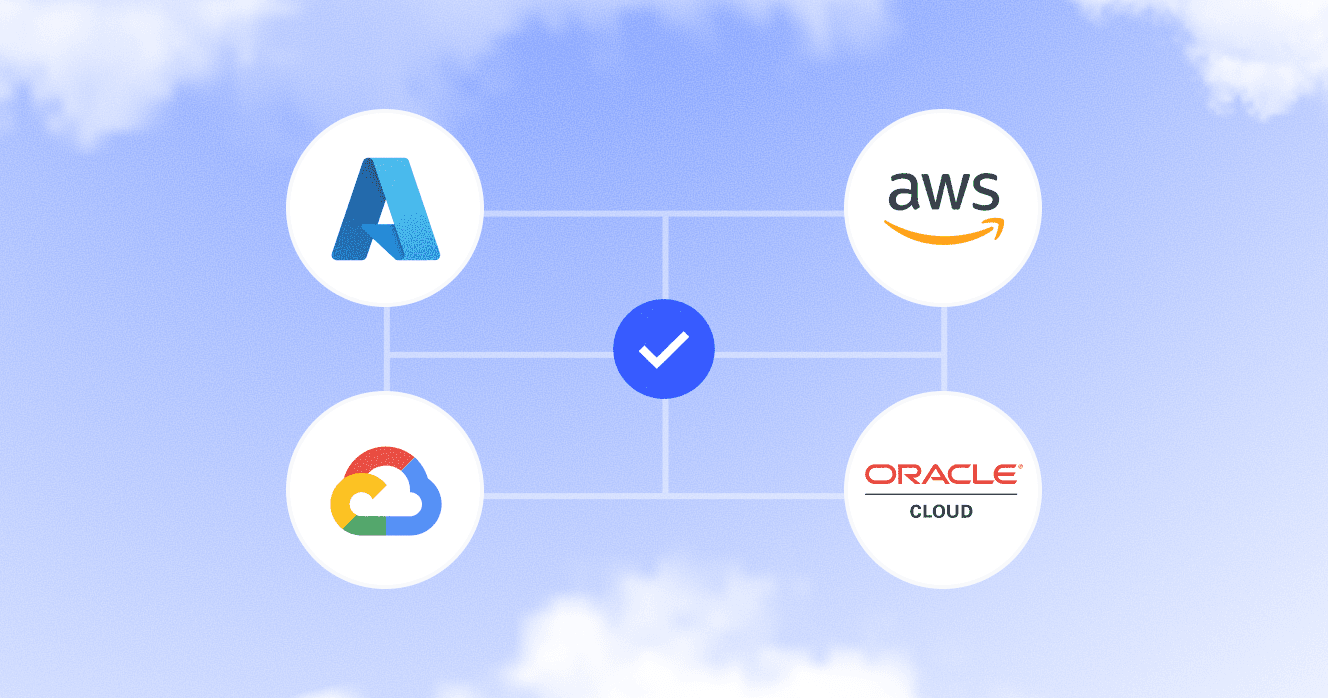
Enterprise-grade DBaaS platforms like Tessell extend this model to multi-cloud orchestration, enabling unified provisioning and management across AWS, Azure, GCP, and OCI from a single control plane. This architecture eliminates the need to manage separate toolchains per cloud.
Key Benefits of DBaaS
Cost efficiency: DBaaS converts capital expenditure on hardware and licenses into predictable operational spend. Pay-as-you-go and subscription billing eliminate the need to overprovision for peak workloads
Elastic scalability: Storage and compute can be scaled independently and in real time. Tessell supports up to 2M IOPS on durable NVMe infrastructure for high-throughput workloads
Reduced operational overhead: Automated provisioning, patching, and monitoring eliminate routine DBA tasks. Teams can redirect capacity from infrastructure management to data engineering and analytics
Faster deployment: Databases that previously required days of setup can be provisioned in minutes, with no manual configuration on individual servers
High availability and disaster recovery: Built-in failover, replication, and backup automation provide continuous availability. Tessell's architecture supports zero RPO/RTO for mission-critical workloads
Expert-managed infrastructure: Providers maintain dedicated expertise across database engines, cloud platforms, and compliance frameworks — reducing reliance on internal specialists for routine infrastructure tasks
Multi-cloud flexibility: True multi-cloud DBaaS platforms eliminate single-vendor dependency, enabling workload portability across AWS, Azure, GCP, and OCI without re-architecting
DBaaS vs PaaS vs IaaS vs Traditional DBMS
Understanding where DBaaS fits relative to other service models is essential for selecting the right deployment approach.
DBaaS occupies a distinct position: it delivers the convenience and managed operations of PaaS, but with specialization in database provisioning, compliance, and performance that generic platform services do not offer.
Common DBaaS Use Cases
Application development and testing: DBaaS enables developers to spin up isolated database environments instantly, run tests, and tear them down without IT provisioning cycles. This accelerates CI/CD pipelines significantly.
SaaS applications: Multi-tenant SaaS products rely on elastic, highly available databases that scale with their customer base. DBaaS removes the infrastructure management burden from product engineering teams.
Data analytics and business intelligence: Analytical workloads require high-throughput, low-latency database access. DBaaS platforms with NVMe-backed storage and automatic scaling support BI tools and data warehousing pipelines without manual tuning.
AI and machine learning workloads: Vector databases and AI-native extensions are increasingly essential for LLM applications. Tessell supports pgvector on PostgreSQL and Milvus for teams building retrieval-augmented generation (RAG) pipelines and AI-enabled applications.
IoT and time-series data: High-frequency sensor and telemetry data requires purpose-built time-series engines. Tessell's TimescaleDB support on PostgreSQL handles IoT, finance, and monitoring use cases at scale.
Packaged enterprise applications: Mission-critical applications like Oracle E-Business Suite demand consistent SLAs and application-aware database management. DBaaS platforms with deep engine support reduce risk in these deployments.
Database Types and Engines in DBaaS
Enterprise DBaaS platforms support both relational and non-relational database engines, covering the full spectrum of modern application data requirements.
Relational Databases
Relational databases use structured schemas and SQL for transactional workloads. They are the default for ERP systems, financial applications, and any workload requiring ACID compliance.
Oracle: Enterprise-grade relational database for mission-critical and high-throughput OLTP workloads. Tessell provides fully managed Oracle on AWS, Azure, GCP, and OCI, including Exadata support.
PostgreSQL: Open-source relational engine with extensive extension support (pgvector, TimescaleDB, PostGIS). Preferred for modern application development and AI workloads.
MySQL: Widely adopted for web applications and SaaS platforms. Tessell provides managed MySQL across multiple clouds.
SQL Server: Microsoft's enterprise relational engine, commonly used in Windows-centric enterprises and .NET application stacks.
Non-Relational Databases
NoSQL and vector databases handle unstructured data, high-velocity writes, and AI embedding workloads that relational engines are not optimized for.
MongoDB: Document-oriented database suited for flexible schemas and developer-centric application architectures.
Milvus: Vector database purpose-built for AI similarity search, embedding storage, and LLM application backends.
Tessell supports all six of these engines across AWS, Azure, GCP, and OCI, providing a consistent management and operations experience regardless of engine or cloud.
DBaaS Deployment Models
DBaaS platforms support multiple deployment patterns to match enterprise cloud strategies:
Public cloud: Databases deployed on shared cloud infrastructure managed by the provider. Offers the fastest provisioning and highest elasticity.
Private cloud: Dedicated infrastructure deployed within the customer's cloud account or data center. Tessell's BYOA (Bring Your Own Account) model deploys entirely within the customer's own cloud account, ensuring data never leaves the customer's control.
Hybrid cloud: Production databases run on-premises or in a private cloud while non-production environments run on public cloud. DBaaS platforms with unified management consoles simplify hybrid operations.
Multi-cloud: Databases are distributed across two or more cloud providers. This eliminates single-vendor dependency and enables workload placement optimization by cost, latency, or compliance jurisdiction. Tessell is the only DBaaS platform covering AWS, Azure, GCP, and OCI with a unified control plane.
Within these deployment models, organizations can choose between dedicated instances (customer-exclusive compute and storage) and serverless patterns (auto-scaling pay-per-request billing). Multi-cloud deployment is the most effective strategy for avoiding vendor lock-in, as it preserves the ability to migrate workloads without re-architecting applications.
Security and Compliance in DBaaS
Security is a shared responsibility in cloud deployments. DBaaS providers secure the infrastructure and platform layer, while customers retain control over data access policies, encryption key management, and compliance configuration.
Enterprise DBaaS platforms deliver the following security capabilities:
Encryption at rest and in transit for all database traffic and stored data
Role-based access control (RBAC) and integration with enterprise identity providers via SSO
Native integration with cloud IAM services (AWS IAM, Azure Active Directory, GCP IAM)
Automated security configuration and continuous compliance monitoring
Network isolation through VPCs and private endpoints, eliminating public internet exposure
Tessell's BYOA (Bring Your Own Account) model is a significant differentiator for regulated enterprises. Rather than placing data in a shared provider environment, Tessell deploys the entire data plane within the customer's own cloud account. The customer owns the infrastructure, and Tessell provides the orchestration layer on top. This model satisfies data sovereignty requirements and simplifies compliance audits.
Tessell holds the following compliance certifications: ISO 27001, ISO 27701, PCI DSS v4.1 (Service Provider Level 1), and SOC 2. These certifications cover financial services, healthcare, and global data protection requirements, including GDPR and HIPAA-eligible workloads.
DBaaS Management and Operations
A fully managed DBaaS platform automates the operational tasks that consume the majority of DBA time in traditional environments:
Monitoring and alerting: Real-time performance dashboards, live log access, and configurable alerting across all database instances and cloud environments.
Automated patching: Scheduled and emergency patches applied during customer-defined maintenance windows, with zero manual intervention.
Elastic scaling: Compute and storage scaled independently on demand, without downtime or manual reconfiguration.
High availability: Automatic failover, cross-region replication, and load balancing ensure continuous availability even during infrastructure failures.
Disaster recovery: Automated backups, cross-region replication, and tested recovery procedures. Tessell supports zero RPO/RTO configurations for workloads where any data loss or downtime is unacceptable.
API-first architecture: All management operations are available via REST APIs and Terraform providers, enabling infrastructure-as-code workflows and GitOps integration.
DBaaS Support and SLAs
SLA terms define the provider's accountability and should be evaluated carefully before vendor selection. Key SLA components include:
Uptime SLA: Guarantees a minimum availability percentage for database services (typically 99.9% to 99.99%).
RPO (Recovery Point Objective): Maximum acceptable data loss in the event of a failure. Tessell supports zero RPO for qualifying configurations.
RTO (Recovery Time Objective): Maximum acceptable downtime following a failure event. Tessell supports zero RTO through automatic failover.
Support response times: Premium support tiers provide dedicated response windows with named support engineers.
SLA terms vary by service tier. Enterprises running mission-critical workloads should prioritize providers that offer contractual RPO/RTO guarantees with financial remedies for SLA breaches, not just best-effort commitments.
DBaaS Pricing Models
DBaaS billing is structured around a consumption-based model that replaces traditional CapEx database licensing and hardware procurement:
Subscription-based: A fixed recurring fee (monthly or annual) covering access to a defined service tier. Predictable costs suit stable production workloads.
Pay-as-you-go: Billing based on actual resource consumption (compute hours, storage GB, data transfer). Suits variable or unpredictable workloads.
Reserved capacity: Pre-committed resource blocks at discounted rates. Appropriate for workloads with predictable baseline demand.
Usage metrics typically include compute (vCPUs and memory), storage (GB provisioned or consumed), I/O operations, and data transfer costs. Comparing DBaaS total cost of ownership (TCO) against on-premises deployment requires accounting for hardware refresh cycles, software licensing, DBA labor, and facilities costs, not just cloud compute pricing.
Tessell's FinOps capabilities include consolidated cost visibility across cloud providers, database consolidation recommendations, and license optimization for Oracle workloads, reducing total database spend without sacrificing performance.
Challenges and Limitations of DBaaS
A balanced evaluation of DBaaS requires acknowledging its constraints alongside its benefits:
Reduced infrastructure control: Customers cannot directly access or configure the underlying hardware. This is a constraint for workloads requiring custom kernel parameters or specialized hardware configurations.
Vendor lock-in risk: Single-cloud DBaaS deployments create dependency on a specific provider's APIs, pricing, and availability. Multi-cloud deployments with a provider-agnostic DBaaS layer mitigate this risk.
Data sovereignty concerns: Regulated industries must verify where data is stored and processed. Providers without regional deployment options or BYOA models may not meet data residency requirements.
Customization limits: Some DBaaS platforms restrict access to advanced database configuration parameters. Verify engine-level customization capabilities before committing to a production deployment.
Compliance responsibility: While providers maintain certifications at the platform level, customers remain responsible for configuring their own compliance posture within the platform.
Tessell addresses the most critical of these concerns: BYOA eliminates data sovereignty and control concerns, four-cloud support removes vendor lock-in risk, and deep engine-level access enables the customization that enterprise Oracle and PostgreSQL workloads require.
How to Choose a DBaaS Provider
Use this framework when evaluating DBaaS vendors for enterprise deployments:
Supported database engines: Confirm the provider supports your current and planned database engines (Oracle, PostgreSQL, MySQL, SQL Server, MongoDB, and vector databases)
Cloud provider coverage: Single-cloud DBaaS creates lock-in. Prioritize platforms with certified support across multiple clouds (AWS, Azure, GCP, OCI)
Security and compliance certifications: Verify certifications relevant to your industry: ISO 27001/27701, SOC 2, PCI DSS, and HIPAA eligibility. Confirm data residency and BYOA options
SLA terms: Review uptime, RPO, and RTO commitments. Distinguish contractual guarantees with financial remedies from best-effort SLAs
Performance guarantees: Evaluate storage I/O, network throughput, and supported instance types. For high-throughput workloads, confirm NVMe or equivalent storage availability
Pricing transparency: Validate that all cost components — compute, storage, I/O, egress, and support — are clearly documented. Request TCO modeling for your specific workload profile.
Migration and onboarding support: Evaluate tooling for migrating from on-premises or other cloud environments without extended downtime.
API and automation coverage: Confirm REST API, Terraform provider, and CLI availability for infrastructure-as-code workflows.
Vendor lock-in mitigation: Assess portability of data and configurations across clouds. Multi-cloud providers with standardized APIs reduce migration costs significantly.
Support quality: Review support tier options, response time SLAs, and access to senior engineers for production incidents.
DBaaS Market Trends and Future Outlook
The DBaaS market is at an inflection point driven by enterprise cloud adoption, AI workload growth, and the increasing complexity of multi-cloud data architectures.
Market growth: The global DBaaS market is projected to grow from $17.2 billion in 2023 to $66.46 billion by 2030, representing a CAGR of over 21%.
AI and vector database adoption: The rise of LLM applications is driving demand for vector-capable databases. pgvector on PostgreSQL and dedicated vector databases like Milvus are becoming core DBaaS offerings for enterprises building AI pipelines.
Serverless databases: Usage-based serverless billing models are gaining adoption for variable workloads, enabling automatic scale-to-zero for non-production environments.
Multi-cloud as default: Enterprise buyers are increasingly requiring multi-cloud portability as a baseline requirement, not a premium feature. Providers limited to a single cloud are at a structural disadvantage.
Edge computing: As latency-sensitive applications push compute and data closer to end users, DBaaS platforms are extending to edge and regional deployment models.
Tessell is positioned at the intersection of these trends: recognized as a Gartner Cool Vendor in Data Management (2025), supporting AI-native database extensions, and delivering the only DBaaS platform with certified support across all four major clouds.
Conclusion
DBaaS is the operational standard for enterprise database management in cloud environments. It eliminates infrastructure overhead, delivers elastic scalability, and gives engineering teams the operational leverage to move faster without compromising reliability or security.
The most important distinction when evaluating DBaaS platforms is not whether to adopt DBaaS, but which provider can deliver the engine coverage, cloud flexibility, and compliance posture your workloads require. Single-cloud, single-engine platforms introduce risk as enterprise data estates grow more complex.
Tessell provides fully managed DBaaS across Oracle, PostgreSQL, MySQL, SQL Server, MongoDB, and Milvus, on AWS, Azure, GCP, and OCI, with zero RPO/RTO, BYOA security, and ISO 27001/27701, PCI DSS, and SOC 2 certifications. Enterprises looking to modernize their data estate and transform DBAs into Data Engineers should evaluate Tessell for their multi-cloud database requirements.
Ready to see Tessell in action?
Book a demo at tessell.com/book-a-demo