
US State IT Services Provider Modernizes Critical Database Workloads on Azure
A central IT services provider for a US state modernized its critical database workloads on Azure with Tessell, achieving a 51% reduction in total cost of ownership while cutting DBA operational effort by more than 40%. The organization brought Azure SQL-like simplicity to complex enterprise databases, reduced provisioning time from weeks to hours, and eliminated third-party backup costs entirely—all while maintaining 99.99% uptime for mission-critical systems serving state agencies and citizens.



~51%
reduction in TCO
>40%
reduction in DBA operational effort
99.99%
uptime for mission-critical workloads
About
This centralized IT services provider supports a US state government by delivering critical technology infrastructure and services to multiple state agencies. With a mandate to modernize operations while maintaining rigorous security and compliance standards, the organization manages enterprise database workloads that power essential public services—from transportation and public safety systems to citizen-facing services like DMV operations. As part of the state's broader FinOps strategy, the organization is focused on maximizing the value of cloud investments while ensuring operational excellence and uninterrupted service delivery to agencies and citizens across the state.
The Challenge
Prior to Tessell, the IT organization faced a combination of operational and strategic obstacles:
- High operational overhead: Manual patching, backups, and scaling consumed significant DBA time, limiting the organization's ability to modernize. The team also faced capacity availability limitations across certain Azure regions, making it difficult to meet high availability and disaster recovery requirements.
- Third-party tooling costs: Dependence on external backup and management tools increased spend.
- Slow time-to-service: Provisioning new databases could take weeks, delaying agency projects.
- Compliance requirements: All workloads needed to meet rigorous state IT governance and security standards.
- Cloud modernization gap: While SQL Server workloads benefited from Azure-native automation, other critical databases remained on legacy infrastructure.
The organization required a cloud-native platform that could streamline database operations, strengthen governance, and deliver measurable efficiency gains - while integrating seamlessly with its Azure environment. To support HA and DR requirements for Oracle workloads on Azure, Tessell provided cloud-native alternatives where RAC is not natively available - ensuring resiliency without capacity bottlenecks.
The Solution: Tessell's Fully Managed Database Service on Microsoft Azure
Tessell enabled the IT organization to modernize its enterprise databases on Azure with:
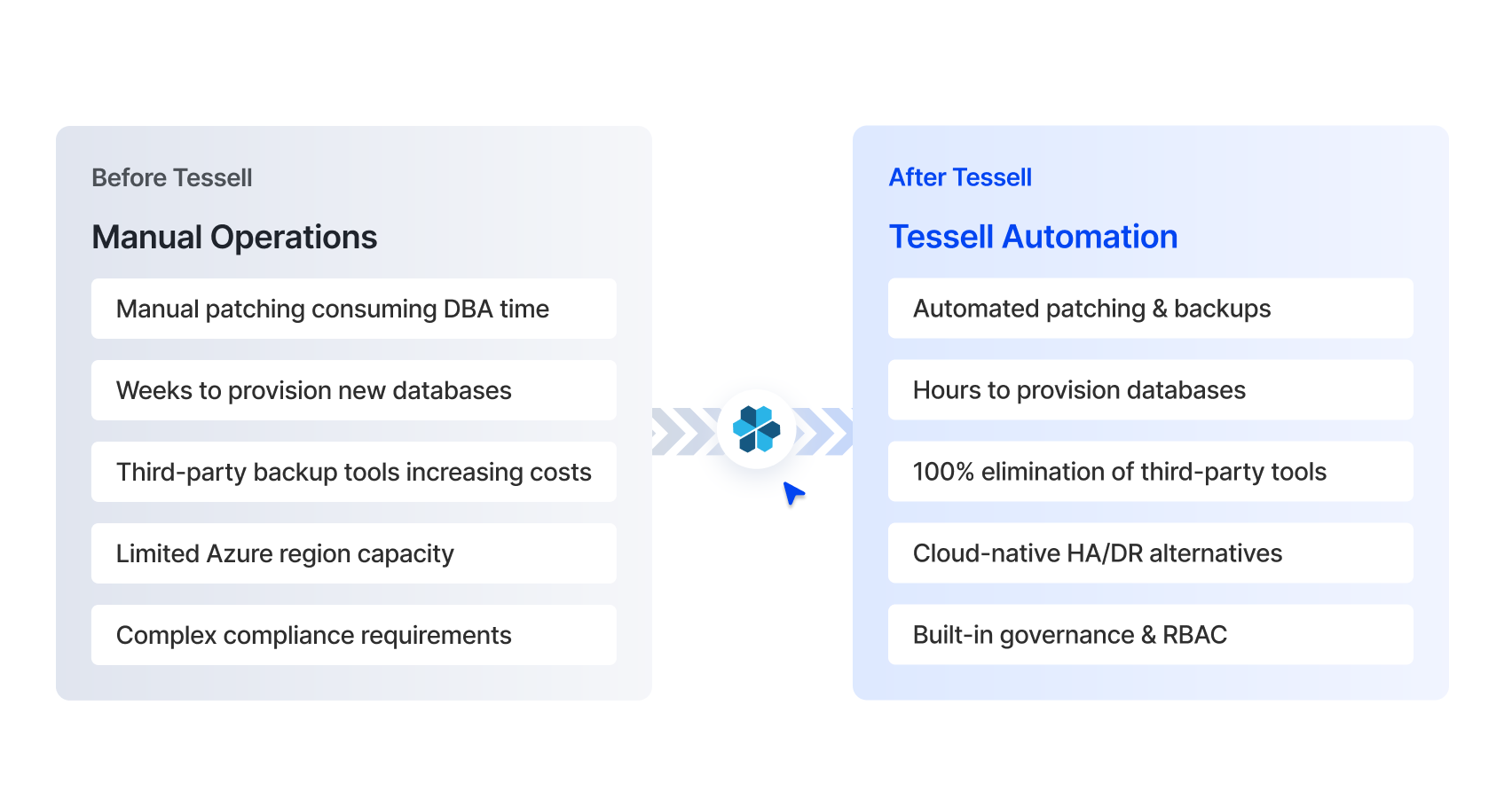
- Automated Operations: Tessell's fully managed service with one-click provisioning, automated patching, backups, and scaling - reducing DBA effort by over 40% and enabling focus on higher-value work.
- Many of the organization's workloads ran on Oracle databases, which required robust high availability and disaster recovery. Tessell enabled these deployments on Azure by leveraging native hardware resources to provide cloud-native alternatives to traditional RAC features - ensuring enterprise-grade resiliency without capacity bottlenecks.
- Operational Efficiency: Streamlined workflows, faster service delivery, and reduced dependency on external tools.
- Security and Compliance: RBAC enforcement, centralized governance, and alignment with state IT policies.
- FinOps-Ready Visibility: Real-time cost tracking and workload right-sizing to optimize spend.
Implementation Approach
The IT organization adopted Tessell through a phased, low-risk rollout designed to validate performance and ensure seamless adoption:
- Proof of Value (July 2024): Migrated 10 production databases into Azure, achieving zero downtime while meeting performance and compliance benchmarks.
- Operational Continuity Phase (April 2025): Maintained production stability through fiscal year-end, enabling agencies to transition without service disruption.
- Statewide Adoption (June 2025): Formalized Tessell as the managed database service of record, expanding usage across multiple state agencies.
This structured approach - supported by Microsoft's ECIF program - ensured smooth integration with the organization's Azure investments and minimized operational risk.
The Results
The organization achieved measurable results across key metrics:

- ~51% reduction in total cost of ownership
- 100% elimination of third-party backup software
- More than 40% reduction in DBA operational effort
- Provisioning time cut from weeks to hours
- 99.99% uptime for mission-critical workloads
When a previous vendor proposed a high-cost migration, Tessell completed the transition at less than a quarter of the projected spend - delivering immediate and measurable budget relief.
Why Tessell?
- Cloud-Native Simplicity: Brought Azure SQL-like ease of use to enterprise database workloads.
- Proven ROI: Delivered cost and efficiency gains from Day 1.
- Security and Compliance: Fully aligned with state IT governance and security requirements.
- Microsoft Partnership: Seamless Azure integration and co-investment support.
- Customer Success Model: Ongoing optimization and high-touch engagement.
Delivering Public Value
Modernization has a direct impact on public services:
- Time-to-Market Acceleration: Faster access to critical data enables state agencies to deliver infrastructure projects more quickly and efficiently.
- Public Safety: Mission-critical systems operate with improved reliability and uptime.
- Citizen Services: Reduced wait times and improved service availability at DMV and other public-facing agencies.
Looking Forward
Over the next 12 months, the IT organization and Tessell will:
- Expand the managed service across additional agencies.
- Quantify and present outcomes to agency stakeholders.
- Explore advanced Azure-native capabilities for high-availability workloads.
- Share the state's modernization framework as a blueprint for public sector transformation.